Twitter

Friday, 6 June 2014

Boss on the Moss


Chair of the RSPB Steve Ormerod was one of the speakers at a celebratory lunch this week to mark the 50th birthday of the Leighton Moss reserve.

He joined staff, volunteeers, local supporters and representatives of funding organisations for an outdoor lunch in the new walled garden behind the Myers Farm visitors' centre.


Dr Ormerod is Professor of Ecology at Cardiff University's School of Biosciences and has been Chair of the RSPB's ruling Council since 2012.

But he was plain Steve Ormerod when he first visited Leighton Moss as a child, travelling to the reserve with his dad from their home in Burnley. 

The Arnside and Silverdale area had always seemed a special place  and still was today, he said. Leighton Moss was a jewel in the RSPB's crown and he was proud to celebrate the reserve's birthday as both RSPB Chair and as a Lancastrian. 

After the speeches the RSPB's Chair cut a Golden 50th Anniversary Ribbon held at either end by the Reserve's two long-serving wardens: John Wilson (far right), now retired, and David Mower on the left of the picture, who retires this year after 27 years at Leighton Moss.    


                                                                                    Art Work

Guests at the lunch also had the opportunity to admire the ceramic art works made by pupils from local schools and used to decorate the walled garden. 


Leah Sierpinski and Adam Lynch, both Year 10 pupils from Dallam School in Milnthorpe, were on hand to represent their school and the hard work and creativity that youngsters and their teachers had applied to the project. 


Tuesday, 20 May 2014

Where's Midge?

Midge is my two year old collie-labrador cross: is that a Lolly or a Cabrador...? Anyway, she's my regular, enthusiastic companion on walks around the area. Admittedly she's much more interested in squirrels, deer and other dogs than the finer points of local history. But she is a fairly good listener.
As we we get closer to the September launch of the Leighton Moss history book, I'll be posting a series of shots of Midge in significant historical locations around the area -- all within a mile or so of the Moss.  The first person to correctly name the location will receive a free copy of the book as soon as it is published. 

So where is this "Me and my Shadow" shot taken? Any thoughts?


Sunday, 18 May 2014

The Mystery of Quaker's Stang


The walk across the salt marsh from Crag Foot to Jenny Brown's Point is one of my favourites. And like nearly every other walker I meet,  I'm intrigued by its name: Quaker's Stang. It begs the immediate questions: who was this Quaker...and what in the name of Jenny Brown is a stang?
I might as well admit from the start: I don't actually know what Quaker's Stang means. But that's not going to stop me theorising! Like many others I have trawled the internet in search of a direct translation. A stang, it seems can be a unit of measurement... same as a perch, apparently, or about five and a half yards in modern currency. It might also mean a pole. It's tempting to picture a seventeenth century Quaker making a perilous crossing of the foreshore equipped with his trusty pole ... or perhaps he (or she) planted one or more strategic waymark poles on the sands to assist travellers. 

But I suspect this attempt at literal translation misses the point. On the modern Ordnance Survey map Quaker's Stang is associated directly with the sea-defences that cross the entrance to Leighton Moss. We talk about walking on Quaker's Stang. 


This embankment -- with its sluice gate on the Lindeth side and fine limestone facings -- was the work in 1840 of Richard Thomas Gillow. Or more accurately,  it was the work of about 20 local men employed by Squire Gillow at 2 shillings and eightpence a day. (Squire Gillow offered them 2/2d a day but they held out for the extra sixpence!)


My suspicion is that names have become a little confused over the years. Looking at Greenwood's map of Lancashire from 1818 -- more than 20 years before the Squire commissioned his sea embankment -- there is a Quaker's Stang clearly marked. But it seems to be referring to the stream that drains the Moss: the stream that today we call Quicksand Pool. 

Greenwood's Map of Lancashire from 1818


 And here we come to a point raised by Rod Ireland, one of the excellent lecturers at the AONB Trust's Landscape History weekend earlier this month. Might Quaker's Stang, Rod suggested,  be a corruption of the much older name Quicksand Pool? In a thirteenth century Warton Manorial Charter the name of the stream draining the Moss is written -- in Latin --  as "Quytsandpole". Perhaps by 1818, repetition, mishearing and mis-transcription  had modified this to Quaker's Stang.  At some point post-1840 the label transferred from the stream to Squire Gillow's new embankment. And just to add to this confusing morass,  the old Quicksand Pool name itself survives on modern maps as the name for the stream. I feel the waters closing over my head. Quick someone, pass me a stang!


Wednesday, 7 May 2014

A Taller Crag Foot Chimney


I'm sure it is no surprise to many local people, but it never occurred to me that the Crag Foot chimney had ever been any taller than it is today. Not so long ago it was quite a bit higher  -- as this photo from M. Moseley's files held at The Northern Mine Research Society clearly shows. The darker top section was brick-built. A few years ago -- I'm not sure how many --  it was becoming unstable. The bricks were pushed into the body of the chimney to avoid accidents. 

Tuesday, 11 March 2014

Happy Birthday Leighton Moss


Birders flocked to the RSPB's Education Room at Leighton Moss on Saturday and Sunday (May 8/9) to enjoy a 50th Anniversary History Exhibition.

John Wilson, founder Warden at the reserve, was on hand to share memories of the RSPB's early days. But he also chipped in with the morning bulletin on the reserve's bearded tit population: although retired since 2000, John is still to be found most days down on the Moss. (NB the "beardies" are doing very well, apparently).


Jacqui Fereday -- the RSPB's Visitor Services Manager -- was kind enough to allow me to advertise my upcoming book on the history of the Moss at the exhibition, and I'm pleased to say there was much more interest than my photograph (right) indicates.


The event also gave me an opportunity to inspect some of the cracking photos that Jacqui and her colleagues have assembled for the anniversary including this nostalgic shot of the mid-1960's "Visitor Centre" on the reserve...or "hut" as it was more commonly known.


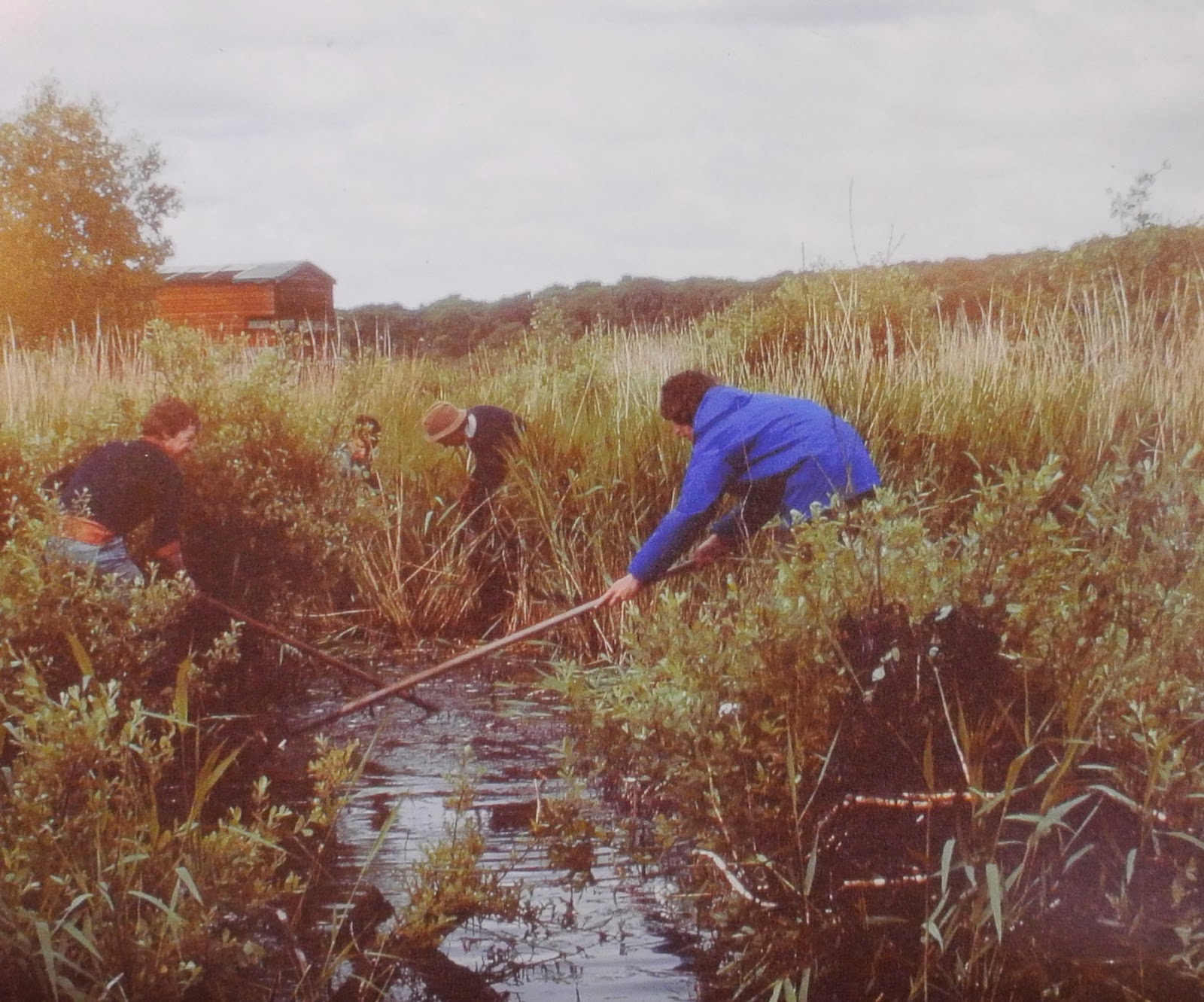
And this evocation of the joys of ditch-clearing, from a decade later.


The birthday events continue throughout the year at Myers Farm and visitors should look out for details of walks and the fun/informative history trail around the Moss.

Meanwhile I'm working with Carnegie Publishing of Lancaster to finish the book --"The Golden Bowl: A History of Leighton Moss" -- in time for a September launch.

Watch this space!

Monday, 2 December 2013

Chimney evidence stacks up

I think we can now say with confidence that the Crag Foot chimney was linked with the 1840's pump that drained Leighton Moss.

Some accounts had suggested that the square-sided chimney was part of the old mine workings that pepper Warton Crag (see my earlier blog entry: 'A Tale of Two Chimneys')  

But this weekend the County's Archaeology Adviser Peter Iles visited the site to compare old maps with the stone-work leading up to the base of the chimney.
Archaeologist Peter Iles at Crag Foot


After the visit he told me: 

"I was personally convinced that the chimney could have served the pumping station site, and that the documents that you have found within the archives strongly indicate that it was rebuilt under the supervision of Richard Gillow from an earlier chimney for this purpose.  The earlier chimney was presumably associated with the mining of iron and copper in the area, but its precise function is unknown."

So the present chimney probably served the Moss pump but it replaced one that may have been linked to the mines. It's good to discover that no-one was entirely wrong! 

The fact that the chimney was so far above the site of the engine house had initially persuaded Peter that the chimney was probably unrelated to the drainage of the Moss.  


But after revisiting the chimney he concluded that there was evidence of a buried stone flue leading from the base of the chimney down towards the site of the long-demolished engine house. 

"What we saw was a stone-built feature leading away from the chimney to the north, apparently constructed with limestone rubble walls and massive limestone capstones.  It appeared to be hollow and thus most probably a flue serving the base of the chimney.  It extended across the garden to Mill Cottage and in the adjacent plot seemed to be continued as a linear mound... At the lower end of this mound, as it proceeded north, it was lost within some garden landscaping, and could not be traced further.  It was possible, however, that at this point it was able to turn more to the northwest around the end of Mill Cottage and head directly towards the site of the pumping station." 

Sunday, 3 November 2013

Bearded Tits and Drizzle Cake


The Autumnwatch team
BBC Autumnwatch has been a wonderful showcase for the wildlife attractions of Leighton Moss and Morecambe Bay. Four days of filming and live broadcasting brought an unaccustomed bustle to the Yealand villages. I've just walked across the Moss and there are more visitors than usual: quite a crowd seeking out the bearded tits. I didn't go into the cafe, but I reckon the queue for the lemon drizzle cake might be even more impressive after Chris Packham's enthusiastic on-screen endorsement. 
Baking aside, the birds, deer and otters were rightly the stars of the show.  But I'm pleased to say the Beeb allowed me a few words about the history of the Moss -- I wrote the first guest blog of the week: 


...and on Tuesday I went on to Autumnwatch Extra and later Unsprung to talk to presenters Euan Mcilwraith and Nick Baker. The producers wanted a few props to illustrate the piece -- so Arthur and Barbara Walker's lump of peat (see post above) achieved its 15 minutes of fame. And Kendal Museum kindly lent me a couple of neolithic items which had been found on the Moss: an exquisite, leaf-shaped arrowhead and a wonderfully tactile stone net-sinker (for weighing down fishing nets). 


A neolithic net-sinker: courtesy Kendal Museum
Because the loan was at very short notice and because museums don't casually hand out their exhibits to enthusiastic amateur historians, the artefacts were accompanied through the evening by two vigilant student-curators from Kendal College: Rory Legge and John Holme. The three of us had a ring-side seat as the Autumnwatch producers and technicians choreographed an hour of live television from the barn at Grisedale Farm on the edge of the Moss. In a past life I was a studio producer for Radio 4's 'Today' programme and I was fascinated to see how a much more complicated live-location tv production was handled. It was a good show, delivered with near-balletic precision. 

I think this is one of the reasons we pay the licence fee.